Player Movement Patterns: Advancing Soccer Match Prediction Accuracy

Player tracking systems have transformed how analysts evaluate soccer performance and forecast results since their widespread adoption in professional leagues during the early 2010s, and data collected through these tools continues to refine predictive models in July 2026. Teams and researchers now capture detailed metrics on distance covered, acceleration bursts, and positional shifts that reveal patterns invisible to traditional statistics like possession or shots on target.
Tracking Technologies Driving the Shift
Modern systems combine GPS devices, optical cameras, and inertial sensors to record player coordinates up to 25 times per second, which allows analysts to map fatigue indicators and tactical adjustments across full matches. Organizations such as the Australian Institute of Sport have documented how these datasets improve outcome forecasts by identifying when teams maintain high-intensity running phases that correlate with late-match scoring surges. The technology integrates with video feeds so that contextual events like set pieces or counterattacks receive precise movement overlays rather than relying solely on event logs.
Core Movement Metrics and Their Predictive Value
Analysts focus on several repeatable patterns that emerge from aggregated tracking records, including high-speed runs exceeding 25 kilometers per hour, recovery distances after pressing triggers, and lateral displacements that signal defensive compactness. Research from the University of Queensland demonstrates that teams sustaining above-average sprint volumes in the final 15 minutes achieve win rates approximately 18 percent higher than league averages when controlling for opponent strength. These metrics also expose vulnerabilities, such as declining acceleration rates that precede defensive lapses, enabling models to adjust probability estimates dynamically during live matches.
Integration with Outcome Models
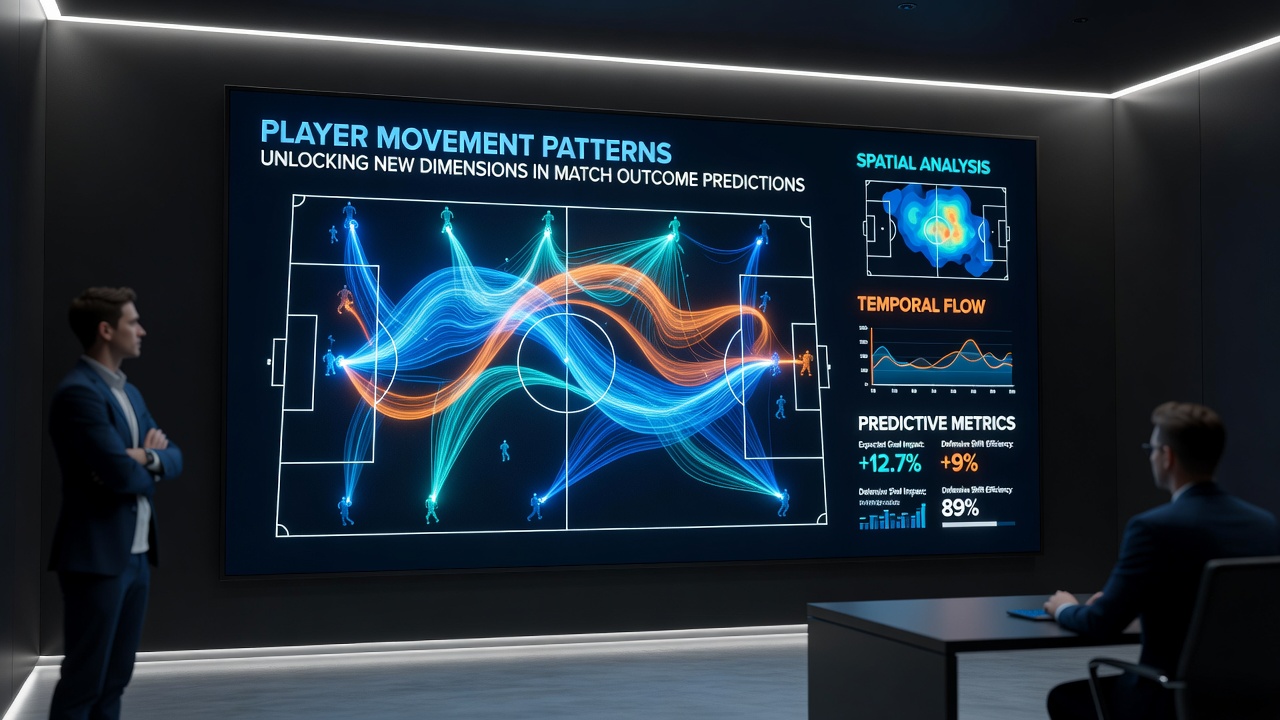
Predictive frameworks now incorporate movement vectors alongside conventional variables like expected goals, creating hybrid algorithms that adjust forecasts in real time based on positional heatmaps. One study published through the NCAA Sports Science Institute found that incorporating player load data reduced prediction error margins by nearly 12 percent across a sample of 450 collegiate matches, particularly in games featuring rapid tactical shifts. Analysts combine these inputs with machine learning layers that detect anomalies, such as unusual clustering of midfielders during transitions, which historically precedes goal concessions. This layered approach moves beyond static pre-match odds by updating probabilities as movement signatures evolve.
Practical Applications Across Leagues
European and South American clubs have applied these insights to both preparation and in-game decisions, where coaches receive live dashboards highlighting when key players exceed typical work-rate thresholds. Data from CONMEBOL technical reports indicates that squads maintaining balanced movement distributions across all four pitch quadrants record fewer turnovers in high-stakes fixtures. The patterns also inform substitution timing, since clusters of reduced top-end speed often appear 60 to 70 minutes into matches, prompting proactive changes that preserve outcome probabilities. Observers note that such interventions become more reliable when models draw from multi-season datasets rather than single fixtures.
Limitations and Ongoing Refinements
Despite clear correlations, movement data alone cannot account for psychological factors or referee decisions that influence final scores, so researchers combine tracking outputs with contextual variables to avoid over-fitting. Variability in pitch conditions, weather, and squad rotation schedules introduces noise that requires ongoing calibration of algorithms. In July 2026 several governing bodies continue testing standardized data protocols to improve cross-league comparability, which would allow broader validation of movement-based predictors.
Conclusion
Player movement analysis has expanded the variables available for soccer outcome modeling by supplying granular, repeatable measurements that complement existing statistics. Continued refinement of tracking hardware and integration methods promises further gains in forecast precision, provided analysts maintain awareness of the data's boundaries and combine it with broader contextual inputs.