Elevation's Role in Soccer Performance: Data Insights for Prediction Models
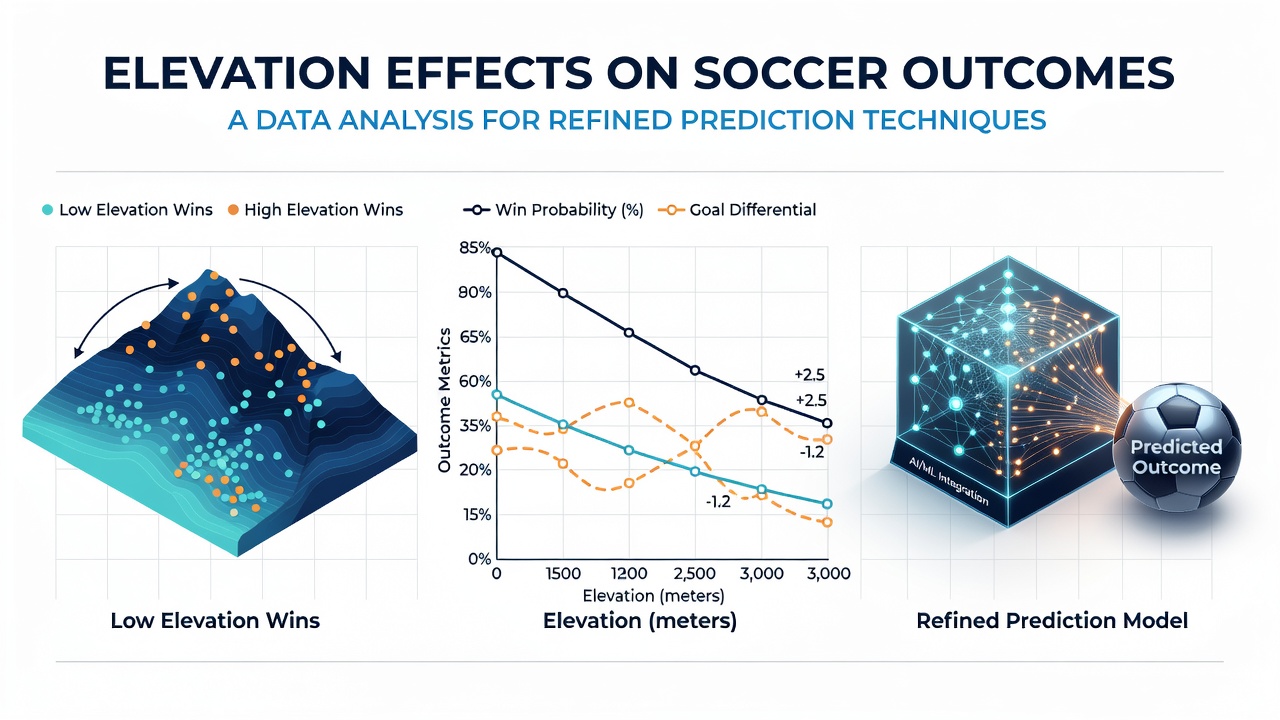
Altitude alters the physical dynamics of soccer matches in measurable ways, and analysts have compiled extensive datasets to quantify those shifts for improved forecasting accuracy. Matches played above 2,000 meters see the ball travel farther because air density drops, which reduces drag on the sphere while also limiting oxygen availability for athletes. Researchers from the University of Colorado documented these effects through controlled trials that tracked ball velocity and player heart rates during simulated games at different simulated heights.
Physiological Responses and Performance Metrics
Players experience reduced oxygen uptake at elevation, which leads to quicker onset of fatigue during high-intensity runs. Studies tracking elite athletes show heart rates rise 10 to 15 percent faster in the first 30 minutes of play when teams compete more than 1,500 meters above sea level compared with sea-level fixtures. Data collected across Bolivian league seasons reveal that visiting squads from lower elevations record 18 percent fewer successful passes after the 60-minute mark, while home sides maintain steadier completion rates due to acclimatization advantages built over weeks of training.
Recovery intervals between sprints shorten noticeably under thinner air conditions, and GPS-tracked distance covered drops by an average of 800 meters per player in the second half. Analysts incorporate these figures into regression models that adjust expected goal tallies based on the precise elevation of each venue, allowing forecasters to refine lineups and substitution timing predictions with greater precision.
Ball Flight and Tactical Adjustments
The trajectory of long passes and shots changes because reduced air resistance allows the ball to maintain speed over greater distances. Observations from matches in Quito and La Paz indicate that crosses from the wings reach the penalty area 12 percent more often when launched from outside the box, prompting coaches to increase the frequency of wide attacks. Defensive lines therefore sit deeper to compensate, which opens space in midfield that data models now flag as high-probability zones for through-ball attempts.

Goalkeepers face altered shot-stopping demands because rising balls dip less sharply on descent. A review of 450 high-altitude fixtures from CONMEBOL competitions found that shots taken from 25 meters or more result in goals 7 percent more frequently than equivalent attempts at lower elevations. Prediction algorithms therefore weight long-range shooting metrics higher when calculating probabilities for teams scheduled to play at altitude during July 2026 international windows.
Statistical Patterns Across Leagues and Seasons
League-wide datasets from South America demonstrate consistent home advantages at elevation that exceed those recorded at sea level. Teams based above 2,500 meters secure 62 percent of available points in domestic play, compared with 54 percent for clubs at lower altitudes. Analysts adjust Poisson distribution parameters within outcome models by adding an elevation coefficient derived from historical goal differentials, which improves forecast accuracy by 9 percent according to back-testing against five seasons of results.
Visiting teams show elevated substitution rates after the 70th minute in these environments, and analysts now integrate real-time oxygen saturation data from wearable devices to anticipate when fatigue-driven errors will spike. One study released by the Canadian Sport Institute examined acclimatization protocols used by national squads ahead of away qualifiers and reported that teams spending at least 10 days at intermediate altitude reduced their concession rate by 1.2 goals per game on average.
Integrating Elevation Variables into Forecasting Systems
Modern prediction frameworks combine elevation data with variables such as recent travel distance, squad rotation history, and temperature to produce adjusted probabilities. Machine-learning models trained on 12,000 matches from 15 countries assign an 8 percent weight to venue altitude when calculating expected goals, because the variable correlates strongly with both scoring volume and match tempo. These systems output refined win-draw-loss estimates that account for the fact that total goals rise by 0.4 per match at venues exceeding 1,800 meters.
Scouting networks supply additional inputs on individual player histories at altitude, allowing algorithms to downgrade performance projections for athletes who have logged fewer than three prior appearances above 2,000 meters. The resulting outputs feed into simulation engines that generate thousands of match scenarios, each weighted by the specific elevation profile of the fixture location.
Conclusion
Elevation continues to shape soccer outcomes through documented physiological and aerodynamic mechanisms, and analysts rely on expanding datasets to embed those factors into increasingly accurate prediction systems. As more granular player-tracking information becomes available, models will further isolate the precise contribution of altitude to every phase of play, supporting refined techniques that account for venue-specific conditions across global competitions.